Course Profiles / New York
Bethpage State Park Black Course: A Course Profile
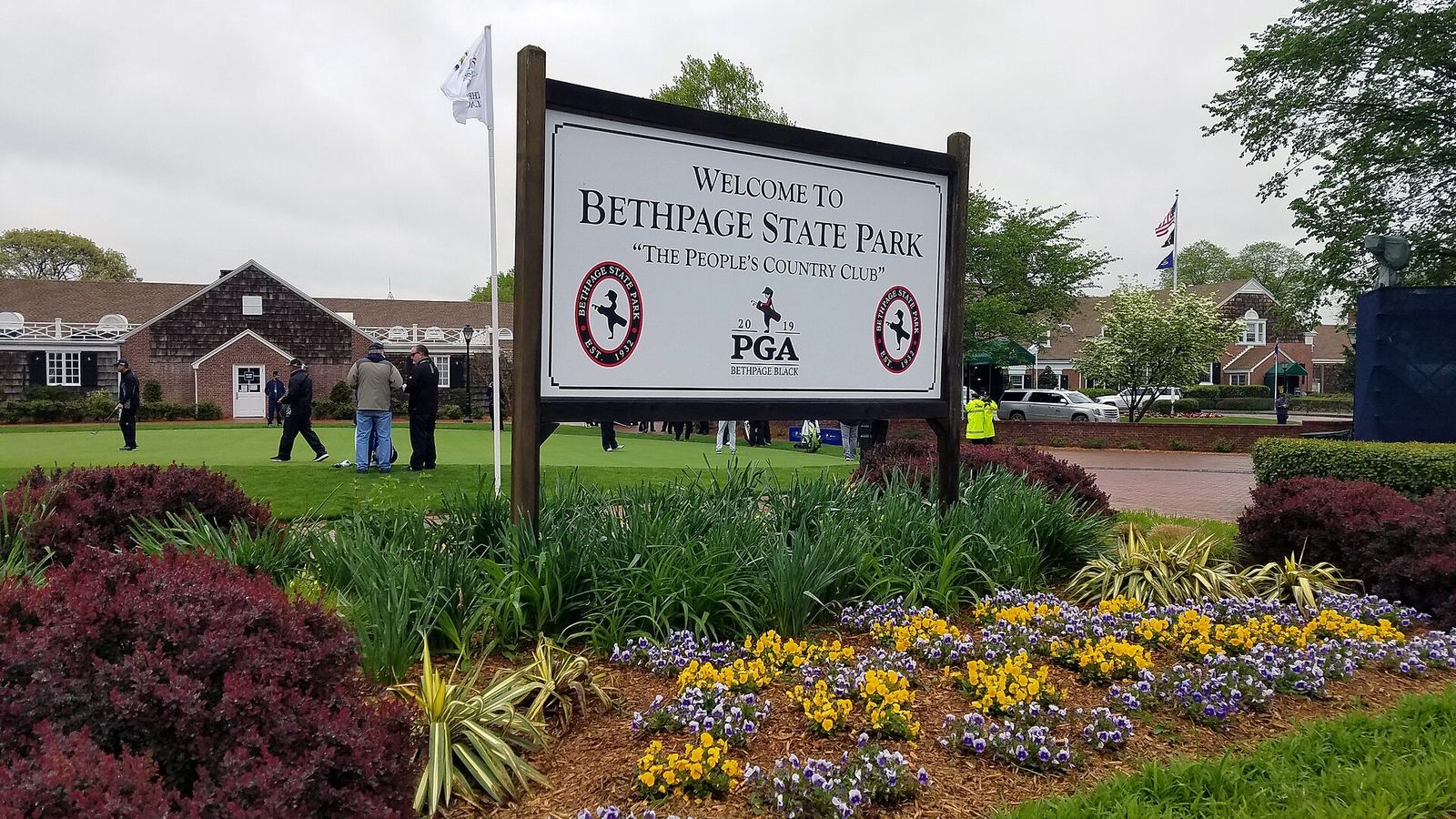
The warning sign at the first tee does the talking before you hit a shot. It tells you, in plain language, that this course is for highly skilled players. Most municipal courses apologize a little for being hard. Bethpage Black warns you, then charges you a public fee to find out if the sign was right.
It usually was. The Black is par 71 and 7,468 yards, with a course rating of 77.5 and a slope of 155. Those numbers are not decoration. They explain why campers sleep in the parking lot for tee times at a place people call the People's Country Club, and why the same place can host the best players alive without softening itself for the occasion.
A public course that keeps winning arguments
A.W. Tillinghast designed it with Joseph H. Burbeck, and it opened in 1936 in Farmingdale, out on Long Island. That date matters because the Black was never a quaint old muni that got lucky. It was ambitious from the start, built big on public land, and it has stayed big in every sense since.
The championship record is the obvious proof. The Black hosted the U.S. Open in 2002 and 2009, the PGA Championship in 2019, and the Ryder Cup in 2025. Tiger Woods won that 2002 Open as the only player under par, which tells you two things at once: the course was playable for a generational talent playing his best, and closed to everybody else. Brooks Koepka shot 63 here in 2019, still the course record, and even that round sits inside a tournament the course was winning most of the week.
We rank it where we do in our Farmingdale town ranking and in the full New York state ranking because the golf comes first, then the day, then what it costs you. On golf alone the Black earns its place. On cost and access it laps most courses with a comparable record. That combination is rare enough that people drive through the night for it.
The test is not subtle, and that is the point. Length off the tee buys you shorter approaches, but it does not buy you safety, because the rating and slope are built on what happens when you miss. A 155 slope is a promise that recovery shots here will often be negotiations, not escapes. Good players like that honesty. They know where they stand on every tee, even when they do not like the answer.
Who it suits, and who it eats
It suits the player who hits it solidly, walks happily, and does not need a round to flatter him. It frustrates almost everyone else, and it does so early enough that there is no point pretending otherwise by the turn. The sign is not marketing. It is the most accurate piece of course information in New York public golf.
Here is the concession, and it is a real one. A course this hard, this busy, and this physically demanding is a poor choice for a relaxed afternoon. If your group wants cold drinks, easy pars, and a finish before dinner without sore legs, the Black will turn a good day into a long story about survival. Plenty of golfers play it once, respect it completely, and never need to do it again. That is not a failure of the course. It is the course working as designed.
There is also the access reality, stated plainly. This is a public, municipal course, and public means everybody gets a shot at it, which is exactly why tee times require overnight camping and patience. Private clubs with this championship history hide behind gates and estimates that put initiation well into six figures. The Black hides behind a sign and a parking lot line. That is a better deal, and a harder morning.
That is also why the Black ages well in memory. Rounds blur together at easier places. Here the bad holes stay specific, the good ones feel earned, and a par made from the wrong side of a fairway counts for more than a birdie handed to you somewhere softer.
Walk off the last green tired, a little beaten up, and clear on one thing: you played the same ground that sorted out Woods, Koepka, and a Ryder Cup, and nobody moved the tees up out of sympathy.