Town Guides / North Carolina
The Pinehurst Golf Guide
The statue gives it away. Behind the 18th green at Pinehurst No. 2 stands Payne Stewart in the pose from his 1999 U.S. Open win, one leg kicked back, putter raised. People take pictures in front of it before their rounds, not after. After would make more sense. No. 2 has a way of rearranging your priorities over four hours, mostly through greens that look holdable from the fairway and then shed your ball into a chipping area like it was never really invited.
That is the correct way to understand a Pinehurst trip. This is not a resort with a famous course attached. It is a cluster of courses in the North Carolina Sandhills built around one Donald Ross examination that has hosted U.S. Opens in 1999, 2005, 2014 and 2024, with more scheduled in 2029, 2035, 2041 and 2047 as the USGA's anchor site. Everything else in town organizes itself around that fact, including how you should order your days.
Start with the anchor, then earn the contrast
Play No. 2 first, or as close to first as your booking allows. Not because it is polite to get the hard part out of the way, but because every other course here reads better once you know what Ross was asking. No. 2 opened in 1907 and Ross refined it until his death in 1948. Bill Coore and Ben Crenshaw restored the sandy waste areas and wiregrass in 2010 and 2011, removing rough and putting the course back on sand. The test is not length or water. It is those crowned, turtleback greens, and the short game required when (not if) you miss them.
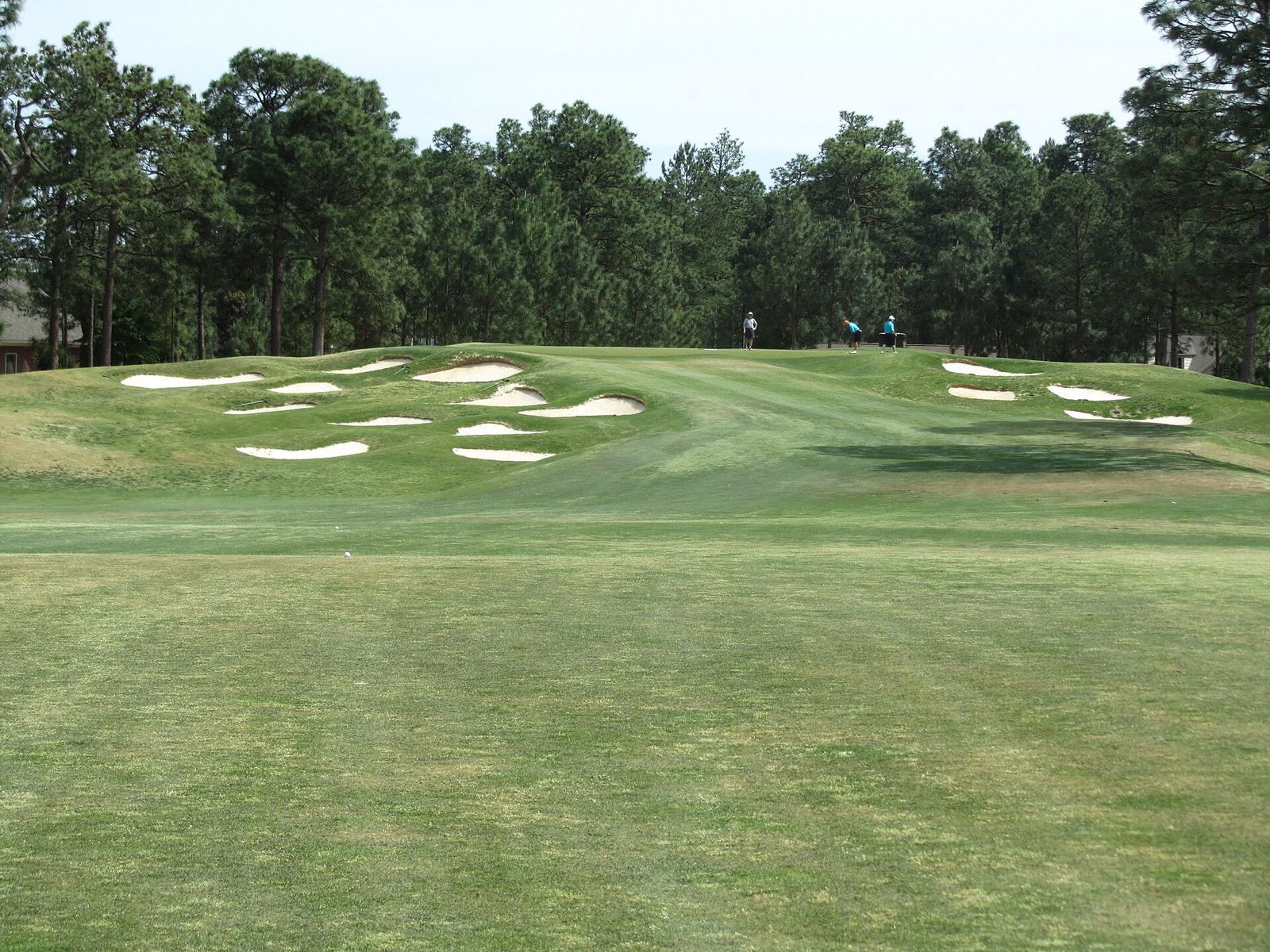
No. 4 should come next, and we would defend that order against anyone who treats it as a consolation round. It carries Ross lineage from 1919, was rebuilt by Tom Fazio in 2000, then fully redesigned by Gil Hanse, reopening in 2018. Hanse kept some of Fazio's routing corridors but rebuilt the greens and bunkering, and his version plays over exposed sand around a central lake. It is visually the boldest of the numbered courses and it co-hosted the 2019 U.S. Amateur with No. 2 a year after reopening. Where No. 2 is a quiet argument, No. 4 talks louder. Playing them back to back is the best architecture seminar in town.
Save No. 10 for the day you want the trip to feel new again. Tom Doak's course at Pinehurst Sandmines opened in 2024 in nearby Aberdeen, the first new Pinehurst course in nearly three decades and Doak's first in the Sandhills. It sits on a former sand mine, with dunes and elevation the main campus never gives you, and the holes through the old mine workings, the Pit area, are the ones people describe on the drive home. It is walkable and rugged in a way that feels imported from somewhere wilder, which is exactly the point.
The rest of the bench, used properly
No. 8 is the breather that is not really a breather. Tom Fazio designed it in 1996 for the resort's centennial, on land that includes Ross's original Gun Club area, away from the main campus. Wetlands and a nature preserve setting change the mood. After two or three days of wiregrass and exposed sand, a course that moves through trees and water lets your eyes rest, even if the scoring does not cooperate.
No. 7, Rees Jones from 1986, is the one to schedule when your group wants a fight. It sits near Ross's former home area, with wetlands and elevation unusual for the resort, and local reputation calls it generally the hardest of the older resort courses. Jones's bunkering and raised greens punish the loose approach in a more conventional, muscular way than Ross does. Play it before No. 2 and it just feels hard. Play it after, and you can feel the difference in philosophy.
No. 9 is the access wrinkle. The Jack Nicklaus design from 1988, formerly The National Golf Club, runs as a private and member side of the operation, with access through Pinehurst membership and resort programs rather than the ordinary tee sheet. Ask early if it matters to your group. Do not build the trip around it and discover the door is only half open.
On money, be clear eyed. No. 2 carries resort access at premium pricing, listed in the record at $400 plus, and No. 10 prices like a new course that knows what it is. No. 4 sits a step below No. 2. Budget for the anchor rounds first and let the rest of the itinerary bend around them, not the other way round.
When to go, and the mistake to skip
The Sandhills reward the shoulder seasons. Spring and fall bring the firm turf and mild air that Ross golf was built for, summer brings real Carolina heat and afternoon storms, and winter rounds are playable more often than northern golfers expect, just with browner grass and shorter days. If your dates touch a U.S. Open year at No. 2, book everything earlier than feels reasonable. The town fills, and it fills with golfers.
The common mistake is playing No. 2 twice and treating the rest as filler. We understand the impulse. It is also wrong. The second No. 2 round costs you the Hanse argument at No. 4 or the mine country at No. 10, and Pinehurst's real strength is that its courses disagree with each other in public. Ross refined one course for four decades here. The resort then let Fazio, Jones, Nicklaus, Hanse and Doak each take a swing at the same sand. That argument, played over four or five days, is the trip.
End at the statue again, after your last round at No. 2 if the schedule allows it. The pose reads differently once the greens have had their say.